
Whitepaper highlighting best practices in wildfire mitigation.
Technical Breakdown of Fire Progression and Mechanical Counter-Measures
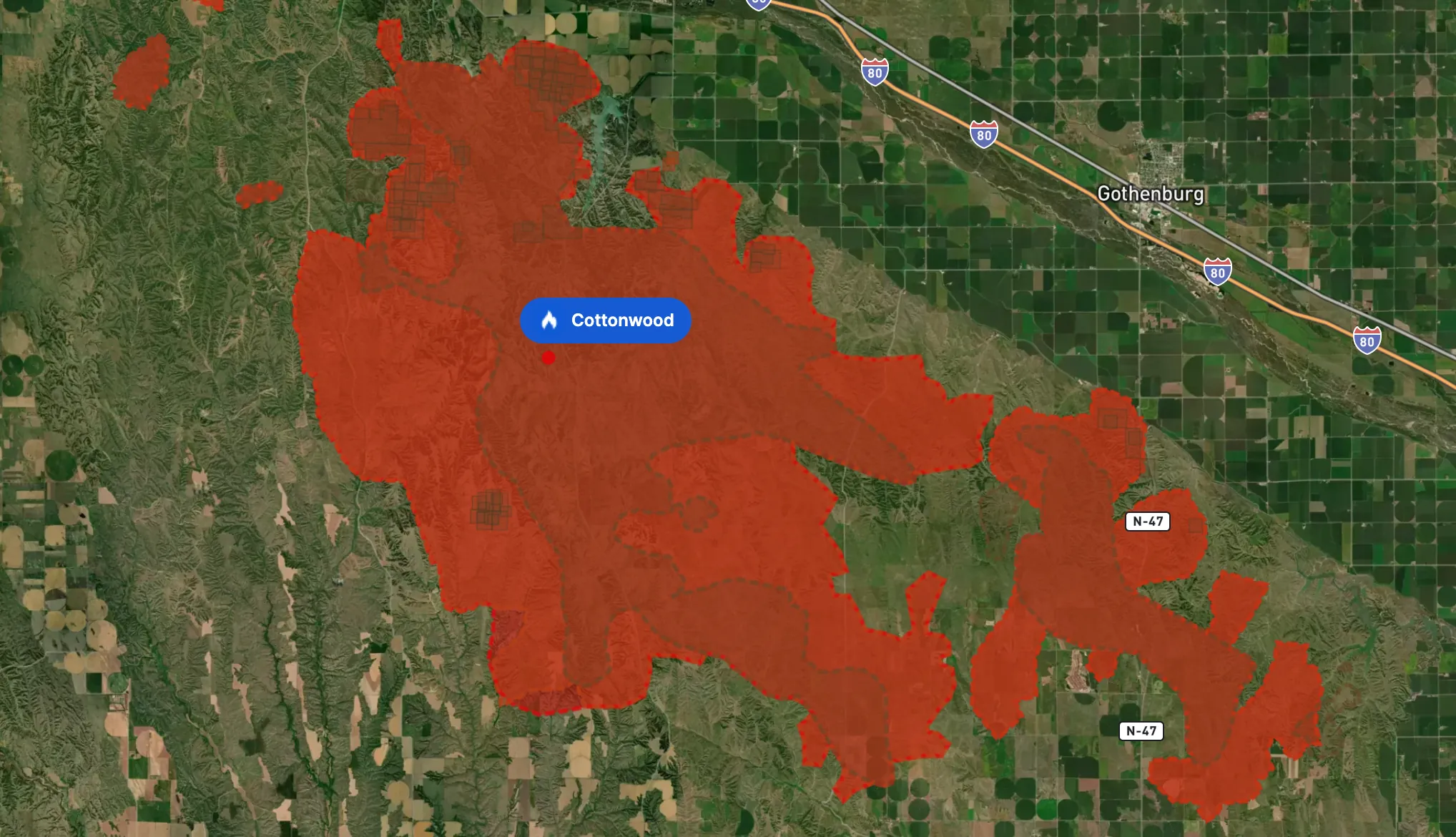
Executive Summary: The “Wall of Fire” Phenomenon As of March 18, 2026, Nebraska is facing its most significant wildfire event in recorded history. The Morrill Fire has consumed approximately 572,000 acres and exhibits a lateral spread rate that defies traditional suppression tactics. The fire’s behavior is driven by a volatile combination of historic low fuel moisture and high-velocity wind shifts, transitioning from a linear “head fire” to a 70-mile wide front in less than 12 hours.
1. Analysis of Fire Speed and Fuel Dynamics The velocity of this complex is rooted in the specific chemistry and architecture of the Nebraska Sandhills fuel bed:
Fuel Load Composition: The landscape is dominated by GR7 (High Load Dry Climate Grass) and invasive Eastern Redcedar .
The “Flash” Factor: With 100-hour and 1000-hour fuel moistures at historic lows, the tallgrass acts as a “fine fuel” conduit. These fuels have a high surface-area-to-volume ratio, allowing for near-instantaneous ignition and energy release.
Rate of Spread (ROS): During the peak of the wind event (gusts exceeding 70 mph), the fire traveled 70 miles in 12 hours . This equates to a sustained ROS of nearly 6 mph —a speed that outpaces traditional bulldozer line construction.
The Cedar Multiplier: Eastern Redcedars, high in volatile oils (fats and waxes), act as “ladder fuels.” They loft firebrands over a mile ahead of the main front, rendering standard 20-foot firebreaks obsolete.
2. MECHANICAL COUNTER-MEASURE: CROSS COUNTRY LAND SERVICES STRATEGY Standard “direct attack” with water and manual raking is insufficient for a 70-mile wall of fire. Our specialized machinery serves as the mechanical antidote for this specific fuel load:
Fuel Continuity: We utilize Mastication to break both vertical and horizontal continuity, turning standing 3-foot-tall grass into a compacted ground mat that burns with 80% less intensity.
Volatile Woody Loads (Invasive Redcedars): Our Mechanical Extraction units neutralize these explosive ladder fuels by grinding them into non-volatile mulch before the fire front arrives.
Rate of Spread: We deploy Rapid Pre-Treatment protocols to prepare miles of defensible “black-line” buffers faster than traditional hand crews, creating a vacuum in which the fire loses energy.
While Maine’s landscape is aesthetically the polar opposite of the Nebraska Sandhills, the underlying thermodynamic risk for 2026 is strikingly similar. Below is a situational parallel analyzing why Maine is currently “ripe” for a high-intensity fire event.
Technical Comparison: Nebraska vs. Maine (March 2026)
1. The Hydrologic Deficit (The “Powder Keg” Foundation) Nebraska’s fire was fueled by multi-year aridification. Maine is currently mirroring this through a deep-layer moisture collapse .
Nebraska: Surface fuels were bone-dry due to a lack of snowpack and summer rains.
Maine: As of March 10, 2026, 100% of Maine is in a drought status, with 53.8% in Severe Drought (D2) . Crucially, groundwater levels and deep soil moisture are at “period-of-record” lows in Central and Southern Maine.
The Parallel: While Maine’s surface may look damp from recent spring thaws, the “duff” layer (the thick mat of pine needles and organic matter) is internally dry. This allows for re-burns and ground fires that are nearly impossible to extinguish with water alone.
2. Fuel Load Analogues: Grass vs. Softwood The “flash” fuels of the Midwest have a direct mechanical equivalent in the Maine woods.
Nebraska’s Grass (GR7): High surface-area-to-volume ratio = Instantaneous ignition.
Maine’s Conifer Slash: Our Spruce-Fir forests, particularly areas with recent harvest residue or “blowdown” from 2025 winter storms, act as the technical equivalent of tallgrass.
The “Ladder” Factor: Just as Nebraska’s invasive Redcedars carry fire into the canopy, Maine’s balsam fir and white pine have low-hanging, resin-heavy branches. These create a vertical “fuse” that moves a manageable ground fire into an uncontrollable crown fire .
3. Rate of Spread (The Wind-Topography Tunnel) Flatland wind gusts drove Nebraska’s speed. Maine’s speed is driven by mechanical channeling .
The Threat: In Maine’s river valleys (Androscoggin, Kennebec), winds are funneled and accelerated. In a drought year, these valleys act as “chimneys.”
Current Metrics: With 1000-hour fuel moisture (large logs/deadwood) hovering around 15–18% in Maine right now—dangerously low for March—the forest has lost its natural “fireproofing” capacity.
4. MECHANICAL COUNTER-MEASURES: STRATEGIC EXECUTION To mitigate these specific fuel loads, Cross Country Land Services utilizes specialized machinery designed for high-density woody reduction. These protocols focus on altering the fuel geometry to collapse the fire’s energy potential:
Fuel Continuity & Dense Slash: We utilize Mastication & Churning to break horizontal continuity and mix mineral soil with dry surface fuels, effectively “killing” the ground fire’s oxygen supply.
Ladder Fuels (Redcedar / Balsam Fir): Our teams perform Vertical Thinning and mechanical limbing up to 8–10 feet, eliminating the critical fuel bridge between the ground and the forest canopy.
Heat Pockets & Heavy Debris: We implement Biomass Compaction to convert airy, volatile logging slash into a flat, dense mulch layer, reducing potential flame lengths from 20 feet down to a manageable 2 feet.
CONCLUSION & STRATEGIC OUTLOOK Maine is currently in a high-risk window. The internal resin-to-water ratio of our softwood forests is skewed toward combustion. Without aggressive mechanical fuel reduction—specifically targeting “ladder” fuels and slash compaction—the 2026 season poses a historic threat to Maine’s timber assets and infrastructure. Related Articles: Maine Wildfire Mitigation: Protecting Your Property and Forests
Discuss Your Project